Category: Towing Tips

Towing and roadside tips for Tuscaloosa drivers from Every Hours Towing Co.

  • Why Towing Your Own Car With a Rope or Chain Behind a Truck Is Riskier Than It Looks

    Why Towing Your Own Car With a Rope or Chain Behind a Truck Is Riskier Than It Looks

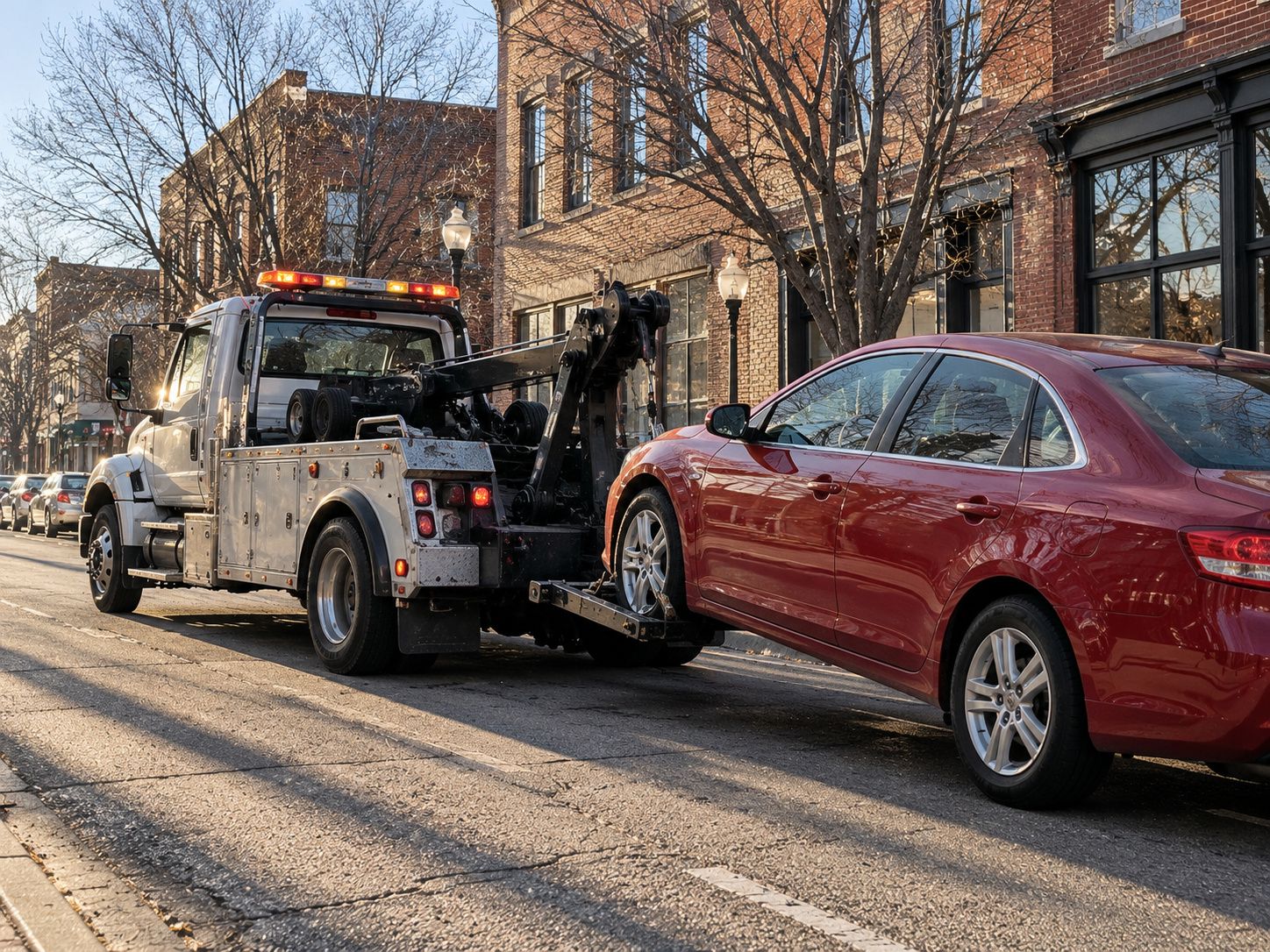
    It’s one of the most common instincts when a car won’t start or won’t move: someone has a pickup truck, someone else has a chain or a tow strap sitting in a garage, and towing the disabled car a short distance yourself feels like the obvious move. Why call and wait for a tow truck when you can just hook up a strap and pull it home or to the nearest shop? It seems simple enough, and plenty of people have done it without incident. But the reason towing companies exist as a dedicated service, with dedicated equipment, isn’t just convenience. It’s because towing a vehicle safely is a lot more complicated than connecting two points with a rope and driving forward.

    Short answer: Towing a car with a rope or chain behind a pickup is riskier than it looks: the slack jerks both vehicles, the towed car has no power steering or power brakes, and a snapping chain hits hard. A wheel lift or flatbed tow avoids all of that. In Tuscaloosa County, call (205) 539-3925.

    The Distance Problem Nobody Thinks About

    A rope or chain connects two vehicles with a fixed length of slack, and that slack is the entire problem. When the towing vehicle accelerates, the slack pulls tight suddenly rather than smoothly, creating a jerking motion that puts sudden stress on both vehicles’ frames, hitches, and whatever the chain or rope is actually attached to. When the towing vehicle slows down or stops, the towed vehicle, now rolling freely with no engine braking and often no power steering or power brakes since the engine isn’t running, continues forward under its own momentum until the slack runs out again, at which point it either stops abruptly against the chain or drifts into the back of the towing vehicle if the driver isn’t reacting fast enough.

    Professional towing equipment doesn’t have this problem because the towed vehicle isn’t connected by a length of slack rope. It’s either rigidly attached (wheel lift) or fully loaded onto a platform (flatbed), which means there’s no jerking, no sudden stops, and no gap for the towed vehicle to build up unpredictable momentum.

    Your Towed Car Has No Power Steering and No Power Brakes

    This is the detail that catches people off guard the most. Power steering and power brakes both rely on the engine running. The moment your car is being towed with the engine off, both systems lose their assist. The steering wheel becomes dramatically harder to turn, enough that a driver expecting normal steering can genuinely struggle to keep the car in its lane, especially at anything beyond a slow crawl. The brakes still technically work, but require significantly more pedal pressure to engage, and most drivers don’t anticipate how much harder they need to push until the moment they actually need to stop and the pedal feels wrong underfoot.

    Combine this with the rope or chain’s slack problem, and you get a scenario where the towed vehicle is difficult to steer, difficult to stop, and prone to sudden jerks, all at once, on a public road, often with other traffic around.

    What Happens If the Rope or Chain Fails

    Ropes and chains not specifically rated for vehicle towing are a common point of failure, and when they fail, they fail while under tension, meaning whatever snaps or comes loose does so with force behind it. A tow strap or chain that separates while both vehicles are moving can become a hazard for both vehicles and anyone nearby, either whipping back toward the towed vehicle or dropping suddenly onto the road in front of it. Professional towing equipment uses rated chains, hooks, and straps specifically designed for the loads involved, inspected and rated for exactly this kind of stress, not general-purpose hardware pulled off a garage shelf.

    The Legal Gray Area

    Most states, Alabama included, have regulations around towing another vehicle on public roads: requirements around tow bar length, the use of safety chains as a backup connection, and in some cases specific lighting requirements for the towed vehicle if its own lights aren’t functional. A casual rope-and-chain setup between two personal vehicles often doesn’t meet these requirements, which can turn a simple breakdown into a traffic stop, a citation, or worse if law enforcement observes the setup and considers it unsafe. This isn’t about scaring anyone away from ever helping a friend. It’s about understanding that “getting the car home” carries more legal exposure than it appears to at first glance.

    When People Usually Try This, and Why That’s the Riskiest Moment

    The rope-and-chain tow almost always happens in a moment of inconvenience rather than genuine emergency: a car that won’t start in a driveway, a vehicle that needs to move twenty feet to get out of the way, a short trip across town rather than a genuine roadside breakdown. The distances involved feel too short to justify calling a tow truck. But short distance doesn’t reduce the risk from the slack, the loss of power steering and brakes, or the potential for the connection to fail. A car being towed a quarter mile down a residential street faces the exact same physical problems as one being towed ten miles. The risk doesn’t scale down with the distance, because the fundamental issues with the setup don’t change.

    What Actually Makes Sense to Do Yourself

    None of this means every situation requires professional equipment. Pushing a car a few feet by hand to get it out of a driveway or a parking space is a completely different scenario from towing it down a road at driving speed. The line is really about whether the vehicle needs to move under tow on a public road at any real speed. The moment that’s the case, the physics of a rope or chain setup become a genuine safety concern rather than a convenient shortcut.

    What a Real Tow Actually Solves

    A wheel lift or flatbed tow eliminates the slack problem entirely, keeps the towed vehicle under proper control the whole way, and doesn’t rely on the towed car’s brakes or steering functioning at all. The vehicle is either rigidly connected or fully supported, which means there’s no jerking, no risk of rear-ending the towing vehicle, and no dependence on a driver managing a car with no power assist while trying to keep pace with another vehicle. It’s not that a rope-and-chain tow can never work: plenty of short, careful, low-speed tows happen without incident. It’s that when something does go wrong with that setup, it tends to go wrong quickly and with real consequences, in a way that professional equipment is specifically designed to prevent.

    Safer Options for a Car That Won’t Move

    Before anyone reaches for a chain, it helps to ask why the car won’t move. Often there’s a simpler fix:

    If the car only needs to move a few feet in a driveway or a private lot, pushing it slowly on flat ground with enough people and someone at the wheel is safer than towing it with a chain. On a public road, call a tow truck.

    Every Hours Towing Co. provides proper wheel lift and flatbed towing throughout Tuscaloosa, AL and Tuscaloosa County, the kind of tow where you don’t have to think about slack, steering, or brakes at all, because none of that is on you.

    Frequently Asked Questions

    Is it legal to tow a car with a chain in Alabama?

    Rules cover things like safety chains and lighting on the towed car. For anything on a public road, a professional tow is the safer choice.

    Is there a minimum distance for a tow?

    No. We tow cars a few blocks or across the county.

    Can a tow strap damage my car?

    Yes. A sudden jerk can damage bumpers, tow hooks and suspension parts, and a strap can snap.

    How much does a tow cost?

    It depends on the vehicle, the distance and where it’s going. Call (205) 539-3925 and we’ll give you the price on the phone.

    Related Services

    Need a Car Moved Safely?

    (205) 539-3925

    Available day and night. Or send a quote request and we’ll call you back.

  • The Hidden Cost of “Just a Little Further”

    The Hidden Cost of “Just a Little Further”

    There’s a decision almost every driver makes at some point, usually without thinking too hard about it. The tire feels a little low, but the next exit is only a mile away. The engine’s running a little hot, but you’re almost home. That grinding sound started a few minutes ago, but pulling over feels like an overreaction. In each of these moments, the choice feels small, just a little further, just to somewhere more convenient to deal with it. But “just a little further” is rarely as small a decision as it feels in the moment, and the gap between what it costs to stop now versus what it costs to keep going is often much bigger than people expect.

    Short answer: Driving just a little further on a flat tire, an overheating engine or grinding brakes often turns a small fix into a big repair. Pull off as soon as it’s safe and call. A tire change or jump start now usually beats a tow and a repair bill later. Call (205) 539-3925.

    The Flat Tire That Becomes a Wheel

    A flat tire is one of the most common things people push through. The car still drives, even if it doesn’t feel right, so the instinct is to get to a safer spot before dealing with it. The problem is that a tire losing air isn’t just going flat. The moment the tire itself stops holding its shape, you’re no longer driving on rubber. You’re driving on the wheel. Every mile after that point grinds down the wheel itself, sometimes badly enough that the wheel can’t be safely used again even with a new tire mounted on it.

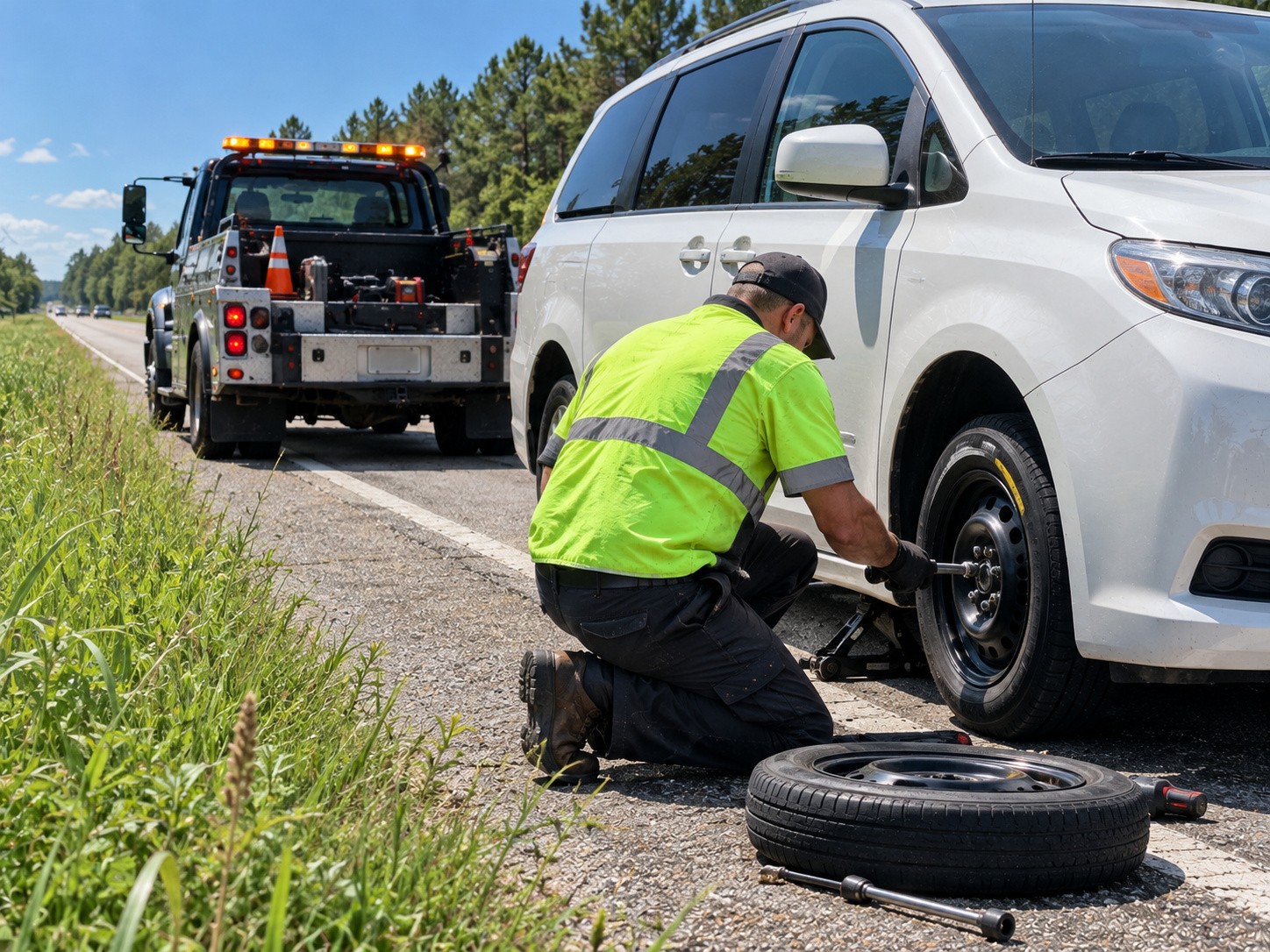
    What would have been a straightforward roadside tire change (swap the flat for your spare, fifteen minutes, done) turns into a wheel replacement, sometimes a tow to a shop that stocks the right wheel, and in some cases damage to the brake components or suspension if the wheel came apart badly enough while still moving. The “little further” in this case can turn a call for a flat tire change into a call for a full tow, plus a repair bill that has nothing to do with the original flat.

    The Overheating Engine That Becomes a Blown Head Gasket

    An engine that’s running hot is telling you something specific: the cooling system isn’t keeping up, for one reason or another. Low coolant, a failing water pump, a stuck thermostat, a leak somewhere in the system. The exact cause doesn’t matter as much as the fact that the engine is no longer being cooled the way it needs to be. Driving further on a hot engine doesn’t give it a chance to catch up. It keeps generating heat while the system that’s supposed to manage that heat continues to fall behind.

    Push it far enough and the damage stops being about the cooling system entirely. A head gasket can blow. Cylinder heads can warp. In serious cases, the engine itself can seize completely, turning a problem that started as “the temperature gauge looks a little high” into an engine that needs to be rebuilt or replaced. The tow that would have happened either way, because an overheating car eventually needs a tow if the problem isn’t fixed roadside, happens either as a straightforward pickup or as the tow that follows catastrophic engine damage. The truck ride is the same distance. The bill on the other end is not.

    The Grinding Noise That Becomes No Brakes At All

    A grinding sound while braking is one of the most commonly ignored warning signs, partly because the car still stops. The instinct is that if the brakes are working, the noise is a minor annoyance rather than an emergency. But that grinding is very often metal on metal, brake pads worn down completely, contacting the rotor directly instead of through a pad. Every mile driven that way removes material from the rotor itself, and eventually from the components behind it.

    Push this far enough and you’re not looking at a brake pad replacement anymore. You’re looking at rotor replacement, potentially caliper damage, and in the worst cases, a genuine loss of braking ability at the exact moment you need it most. This is one of the few “just a little further” decisions that isn’t just expensive. It’s genuinely dangerous, both to the driver and to whoever else is on the road at the time.

    Why This Matters for the Call You Eventually Make

    Here’s the part that connects all of this back to roadside assistance directly: the type of help you need changes based on how far you push a problem before you stop. A flat tire caught early is a fifteen-minute roadside tire change. A flat tire pushed for five more miles is often a tow, because the wheel and possibly the suspension are no longer safe to drive on at all. An overheating engine caught early might just need a coolant top-off and a trip to a mechanic under its own power. An overheating engine pushed until it seizes needs a tow no matter what, because the vehicle physically cannot run anymore.

    The honest reality is that stopping early usually means a smaller, simpler call, sometimes something you can resolve on the shoulder in fifteen minutes without needing a tow at all. Pushing further almost always means a bigger call, more often a tow, and sometimes a repair bill that has nothing to do with the original problem and everything to do with the extra miles driven after the warning sign showed up.

    The Actual Cost-Benefit, Laid Out Plainly

    Stopping when something first feels wrong costs you time. You lose ten or fifteen minutes pulling over, assessing the situation, and possibly calling for help. That’s the entire cost. It’s inconvenient, especially if you’re in a hurry or in an unfamiliar spot, but it’s a fixed, small, predictable cost.

    Continuing on costs you an unknown amount, and that’s the real issue. Sometimes “just a little further” genuinely costs nothing extra. You make it to your destination and deal with it there without consequence. But when it doesn’t work out that way, the cost isn’t fifteen extra minutes. It’s a wheel instead of a tire, an engine instead of a coolant top-off, a caliper and rotor instead of a brake pad. The math only works in your favor if nothing goes wrong, and the entire premise of a warning sign is that something already has.

    What to Actually Do Instead

    None of this means every unusual noise or gauge fluctuation requires immediately stopping on a busy road. Sometimes finding a safer spot a short distance away is the right call. The distinction is between finding a safer spot to stop and address the problem versus continuing on with the intention of dealing with it “later” once you’re home or somewhere more convenient. If a tire is losing air, get off the road as soon as it’s safe to and call for a tire change before continuing rather than trying to make it home first. If the temperature gauge is climbing, pull off and let the engine cool rather than pushing toward the next exit. If something is grinding, stop and call for a tow rather than driving further to see if it gets worse.

    Every Hours Towing Co. handles both ends of this: flat tire changes and jump starts for the problems caught early, and towing for the ones that got pushed too far. Either way, the sooner you call, the smaller the problem usually is by the time we get there.

    Frequently Asked Questions

    How far can I drive on a flat tire?

    Ideally not at all. Driving on a flat can ruin the wheel within a short distance. Pull off where it’s safe and call for a tire change.

    What should I do if my temperature gauge is climbing?

    Pull off when it’s safe, turn the engine off and let it cool. Don’t open a hot radiator cap. If it keeps overheating, call for a tow.

    Is it safe to drive with grinding brakes?

    No. Grinding often means metal on metal, and braking can get worse quickly. Stop and call for a tow.

    Do you change tires and jump-start cars too?

    Yes. We change flat tires, jump-start batteries and deliver fuel across Tuscaloosa County.

    Related Services

    Pulled Over in Tuscaloosa?

    (205) 539-3925

    Available day and night. Or send a quote request and we’ll call you back.

  • The Difference Between Being Stuck and Being Broken Down, and Why It Matters for Who You Call

    The Difference Between Being Stuck and Being Broken Down, and Why It Matters for Who You Call

    When something goes wrong with your vehicle on the road, the instinct is to call for help first and figure out the details later. That’s not a bad instinct. Getting help on the way quickly is always the right priority. But there’s a distinction that most drivers don’t think about until they’re already in the situation, and it’s one that affects which service you actually need, how fast you can get back on the road, and sometimes how much the whole thing costs you. The difference between being stuck and being broken down sounds simple on the surface, but in practice the line between them gets blurry fast.

    Short answer: If your vehicle runs but can’t move because it’s in mud, a ditch or soft ground, you’re stuck and usually need a winch-out. If it won’t start or can’t drive, you’re broken down and usually need a tow or roadside help. Not sure? Describe it when you call (205) 539-3925.

    What “Broken Down” Actually Means

    A breakdown is a mechanical or electrical failure that prevents your vehicle from operating under its own power. The engine won’t start. The transmission failed. The alternator died and the battery drained completely as a result. A belt snapped. The radiator overheated to the point where driving further would cause serious engine damage. A tire blew out and the wheel itself is damaged beyond rolling safely.

    In all of these cases, the vehicle has a problem that needs to be diagnosed and repaired before it can be driven again, and in most cases, it needs to be transported somewhere else first. A breakdown almost always ends in a tow, because the vehicle can’t get to a mechanic under its own power and leaving it where it stopped isn’t a long-term option.

    The defining characteristic of a breakdown is that the vehicle itself is the problem. Something inside it, or on it, has failed. Getting it unstuck or giving it a push won’t solve anything. It needs mechanical attention.

    What “Stuck” Actually Means

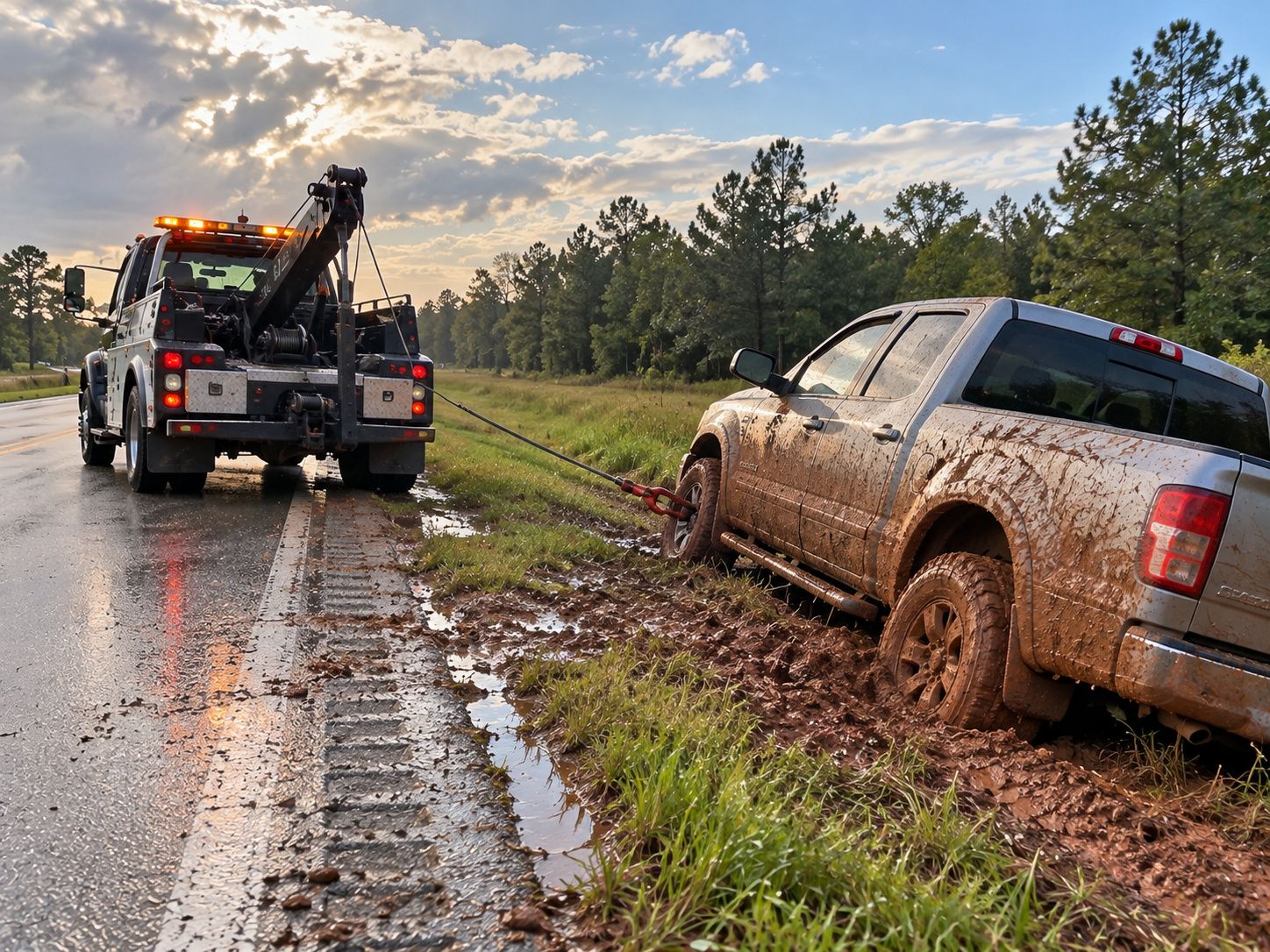
    Being stuck is a different situation entirely. A stuck vehicle isn’t necessarily broken. It just can’t move from its current position under its own power because of where it is or what it’s in, not because of anything wrong with the vehicle mechanically. A car that slid off a wet road into a ditch with the engine still running is stuck, not broken down. An SUV that drove onto soft ground and sank into the mud is stuck. A vehicle that rolled too close to a curb and beached itself on the concrete lip is stuck. An RV that pulled into a campsite with softer-than-expected ground and can’t get traction to back out is stuck.

    In all of these cases, the vehicle itself is fine. If you could somehow lift it back onto solid, level ground, you’d drive away without a problem. The issue isn’t mechanical. It’s positional. And that distinction matters enormously for what kind of help you need.

    Why the Distinction Matters for Who You Call

    A broken-down vehicle almost always needs a tow. It needs to be transported from where it stopped to somewhere it can be repaired. A stuck vehicle usually needs a winch-out. It needs to be pulled free from its current position and returned to a surface it can drive on, after which the driver can continue on their way without going anywhere near a mechanic.

    These are two different services, and confusing them can cost you time. If you call for a tow when what you actually need is a winch-out, the driver arrives expecting to load your vehicle and transport it somewhere, and may need to reassess the situation on arrival, adjust the approach, or in some cases call for different equipment. If you describe a stuck vehicle as broken down, you might end up with the wrong expectation about where your car is going and what happens next.

    The practical upshot is this: when you call for help, the most useful thing you can tell the dispatcher isn’t just “my car won’t move”. It’s whether the car is mechanically capable of moving or whether it’s physically prevented from moving by its position. One sentence covers it. “My engine is running but I slid into a ditch and I can’t get traction” tells us immediately that this is a winch-out situation. “My car died while I was driving and it won’t restart” tells us this is a tow.

    The Cases Where It’s Genuinely Hard to Tell

    The distinction gets complicated in a few real-world scenarios that drivers run into regularly.

    The first is a blown tire on soft ground. If you got a flat tire and pulled off the road onto a soft shoulder to change it, and now your vehicle has sunk slightly into the mud while sitting there, you’re dealing with both at once, a mechanical issue that needs roadside assistance and a positional issue that might need a winch-out before the tire can even be changed. In a case like this, the right call is to describe both things when you call: “I have a flat tire and I pulled off onto a soft shoulder and now I’m slightly stuck.”

    The second is a dead battery in a bad spot. If your battery died and your car rolled to a stop at the bottom of a hill or in a spot where it’s partially blocking traffic, you have a breakdown that also creates a positional problem. A jump start might fix the mechanical issue, but getting the vehicle safely out of its current position might need something more than just a running engine. Again, describing the full situation, not just the symptom, gives the dispatcher a complete picture.

    The third is running out of fuel on a slope or soft shoulder. An empty tank is a breakdown in the sense that the vehicle won’t run, but it’s one of the few breakdowns that can be solved on the spot without a tow, unless the vehicle’s position creates a separate problem once it’s fueled.

    What to Say When You’re Not Sure

    If you genuinely can’t tell whether your situation is a stuck or a breakdown, or if it’s some combination of both, the simplest approach is to describe what happened and what you observe right now. Tell us whether the engine is running or not, whether the wheels can turn, whether the vehicle is on a flat surface or not, and what happened immediately before the vehicle stopped moving. From that description, an experienced dispatcher can usually identify what you need and send the right equipment.

    You don’t need to arrive at the answer yourself before you call. Knowing the difference between stuck and broken down is useful, but describing your situation accurately is more useful than labeling it correctly. What slows a towing call down isn’t a driver who doesn’t know the right terminology. It’s a driver who leaves out the details that tell us what we’re actually dealing with.

    Where Drivers Get Stuck Around Tuscaloosa County

    Most of our winch-out calls come from the same kinds of places:

    • Soft shoulders after a summer storm, when a driver pulls off to wait out the rain and the ground gives way
    • Red clay roads and driveways that turn slick and sticky after rain
    • Gravel and dirt roads in the rural parts of the county, around Moundville, Coker and Brookwood
    • Boat ramps and lake access roads around Lake Tuscaloosa and the Black Warrior River
    • Grass lots used for event parking, which soften fast in wet weather

    In every one of these, the car itself is usually fine. Tell us the engine runs and the wheels just spin, and we’ll bring a truck with a winch instead of planning a tow to a shop.

    Every Hours Towing Co. handles both (winch-outs for stuck vehicles and towing for breakdowns) throughout Tuscaloosa, AL and all of Tuscaloosa County. When you call, describe what you’re seeing and we’ll take it from there.

    Frequently Asked Questions

    Is a winch-out cheaper than a tow?

    Often, because the vehicle is pulled free and driven away instead of hauled somewhere. Call (205) 539-3925 and we’ll give you a price on the phone.

    Can you winch out a truck stuck in red clay mud?

    Yes. We winch out cars, pickups, SUVs and smaller RVs from mud, ditches and soft shoulders.

    What if my car is stuck and won’t start?

    Then it’s both. We can winch it free, then jump-start it or tow it to a shop.

    Should I keep spinning the wheels to get out?

    No. Spinning digs the tires in deeper and can strain the transmission. Stop and call.

    Related Services

    Stuck or Broken Down in Tuscaloosa?

    (205) 539-3925

    Available day and night. Or send a quote request and we’ll call you back.

  • What to Tell the Tow Truck Driver When You Call (Most People Get This Wrong)

    What to Tell the Tow Truck Driver When You Call (Most People Get This Wrong)

    Most people have never had to call a tow truck before the moment they actually need one. And when that moment comes (stranded on the side of the road, stressed, maybe in the dark or the rain) it’s easy to fumble the call in ways that slow everything down. The information you give when you call a towing company directly affects how fast the right truck gets to you, whether it’s the right truck for your vehicle, and how smoothly the whole situation gets resolved. Here’s what actually matters when you make that call, and what most people either forget or get wrong.

    Short answer: When you call a tow truck, give your exact location (road, direction and nearest exit or mile marker), your vehicle’s year, make, model and drive type, what happened, whether the wheels can roll, and a phone number you’ll answer. In Tuscaloosa County, call Every Hours Towing Co. at (205) 539-3925.

    Your Exact Location: Not Just a General Area

    This is the single most common problem on towing calls. “I’m on McFarland Boulevard” or “I’m somewhere near the university” isn’t enough to find you quickly, especially at night or in an area where one stretch of road looks identical to the next from a truck window.

    What we actually need: the nearest cross street or intersection, the nearest mile marker if you’re on an interstate, the nearest exit number if you can see one, and which direction you’re traveling or facing. If you’re in a parking lot, the name of the business helps more than the street address. If you’re in a neighborhood, the house number you’re parked in front of is better than just the street name.

    If you genuinely don’t know where you are, open your maps app before you call and either read us the address it shows for your current location or drop a pin and read the coordinates. A dropped pin takes about five seconds and eliminates the back-and-forth entirely. In the Tuscaloosa area specifically, some of the roads between exits on I-20 and I-59 can look very similar, and a mile marker number gets our driver to the right spot immediately instead of searching a two-mile stretch of shoulder.

    The Year, Make, Model, and Drive Type of Your Vehicle

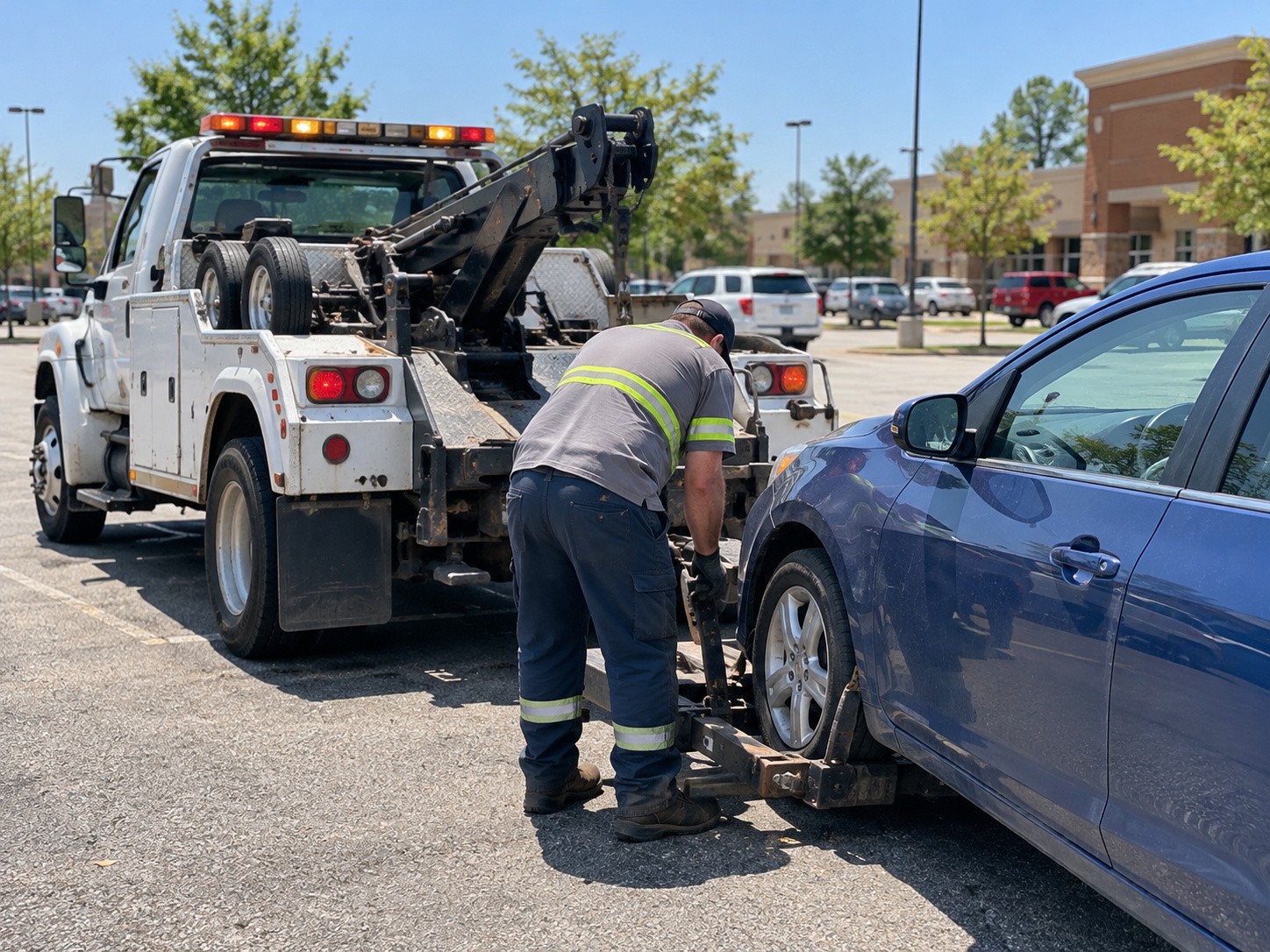
    Not every tow truck is right for every vehicle, and knowing what we’re coming to pick up before we leave the yard means we bring the right equipment the first time. A front-wheel-drive sedan and an all-wheel-drive SUV are not the same tow. The SUV needs a flatbed to avoid drivetrain damage, while the sedan can often be handled with a wheel lift. A motorcycle needs different rigging than a pickup truck. An RV needs completely different equipment than a standard passenger car.

    The year and make matter too, but the drive type (front-wheel drive, rear-wheel drive, all-wheel drive, or four-wheel drive) is the most important piece of information for determining which truck to send. If you don’t know your drive type off the top of your head, check your owner’s manual or look it up quickly on your phone before or during the call. It’s a detail that can save you from waiting for a second truck to show up because the first one wasn’t equipped for your vehicle.

    What Actually Happened: Not Just “It Won’t Start”

    “My car won’t start” covers about a dozen different problems, some of which need a jump start, some of which need a tow, and some of which need a specific type of tow. The more detail you can give about what happened leading up to the breakdown, the better we can prepare before arriving.

    Did the engine cut out suddenly while you were driving, or did it just not start when you turned the key? Did you hear any unusual sounds (grinding, clicking, a loud pop) before it stopped? Are any warning lights on, and if so which ones? Did the car overheat? Is there fluid leaking underneath it? Did you run out of gas, or do you have fuel in the tank? Is the car in the middle of the road, partially off it, or fully on the shoulder?

    None of this requires you to be a mechanic. You don’t need to diagnose the problem. That’s not your job. But describing what you saw, heard, and experienced gives the driver a much clearer picture of what they’re walking into than a vague description of the symptom alone.

    Whether the Vehicle Can Roll and Whether the Wheels Turn

    This one catches people off guard because it’s not an obvious thing to think about in a stressful moment, but it matters for how we hook up the vehicle. If the brakes are seized, if a wheel is bent or blown out completely, if the steering is locked, or if the transmission is stuck in park and won’t release, the approach to loading or hooking up the vehicle changes. A car that can’t roll at all needs to be handled differently from one that rolls freely. Telling us upfront saves time on arrival and reduces the risk of anything going wrong during the hookup.

    Your Phone Number: One That You’ll Actually Answer

    This sounds obvious but it gets missed more often than you’d think. Give us a number you’ll have with you and will pick up when we call, not a home number or an office number you’re not near. Our driver may need to call you when they’re close to confirm your exact location, especially if you’re in a spot that’s hard to find from the road. If your phone battery is low, tell us that too so we know to reach you quickly rather than assuming you’re not answering.

    What You Don’t Need to Know

    People sometimes hesitate to call because they’re not sure what’s wrong with their car, or because they don’t know exactly what service they need. That’s completely fine. Figuring out what you need is part of what happens when we arrive. You don’t need to know whether you need a wheel lift or a flatbed, whether you need a jump start or a full tow, or whether your problem is the battery or the alternator. The more detail you can give about your situation the better, but not knowing the answer to those questions isn’t a reason to hesitate on the call.

    What slows things down isn’t a caller who doesn’t know what’s wrong with their car. It’s a caller who doesn’t know where they are. Location first, everything else second.

    One Thing Worth Doing Before You Ever Need to Call

    The best time to think about what you’d say on a towing call is before you ever need to make one. Know where your vehicle registration is, because it has your year, make, and model on it. Know whether your vehicle is front-wheel drive, rear-wheel drive, or all-wheel drive. It’s in the owner’s manual and takes thirty seconds to look up. Know roughly where your spare tire is, even if you never plan to change it yourself. And if you drive I-20 or I-59 regularly, pay attention to exit numbers and mile markers occasionally. The ones you drive past every day are the ones you might need to report when you’re stuck.

    None of this takes more than a few minutes of preparation. And if you ever do end up stranded and calling for help, those few minutes are what turn a stressful call into a quick, efficient one.

    Every Hours Towing Co. serves Tuscaloosa, AL and all of Tuscaloosa County. When you call, we’ll ask the right questions to get the right truck to you, but the more you can tell us upfront, the faster we move.

    Frequently Asked Questions

    What’s the most important thing to tell the dispatcher?

    Your exact location. A road name, your direction and the nearest exit, mile marker or business gets the right truck to you.

    Why do you ask if my car is all-wheel drive?

    AWD and 4WD vehicles usually need a flatbed so the drivetrain isn’t damaged. Knowing ahead of time means we send the right truck the first time.

    Do I need to know what’s wrong with my car?

    No. Just describe what happened, what you heard and which warning lights came on. We’ll work out the right service.

    Can I share my location from my phone?

    Yes. A map pin or coordinates from your phone work well, especially at night or on rural roads.

    Related Services

    Need a Tow in Tuscaloosa County?

    (205) 539-3925

    Available day and night. Or send a quote request and we’ll call you back.
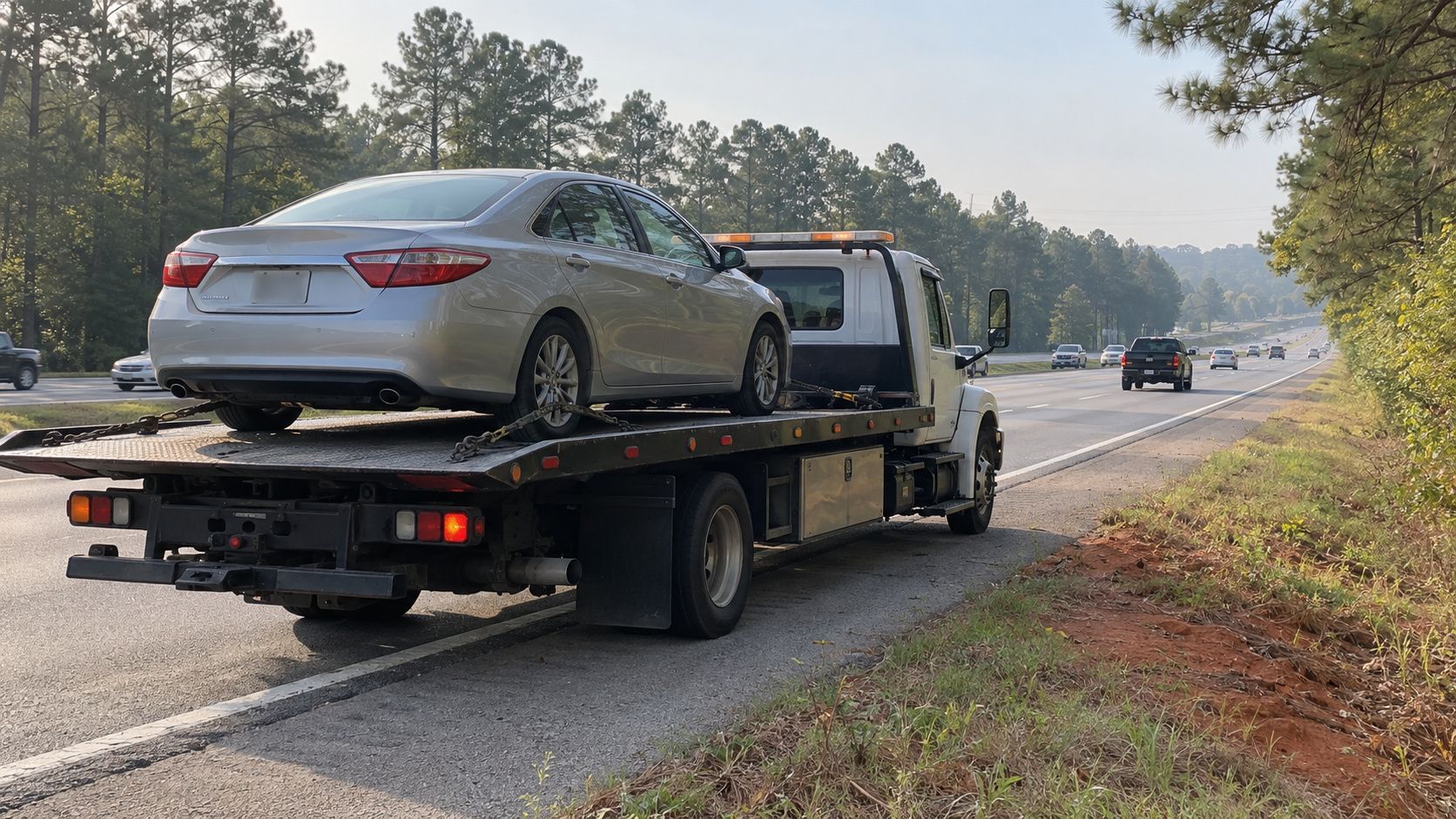

  • What Happens in the First 10 Minutes After Your Car Breaks Down on I-20 or I-59

    What Happens in the First 10 Minutes After Your Car Breaks Down on I-20 or I-59

    Breaking down on an interstate is a different situation from breaking down in a parking lot or on a quiet side street. The vehicles around you are moving fast, the shoulder is narrow, and the decisions you make in the first few minutes matter more than most drivers realize. I-20 and I-59 run directly through Tuscaloosa and the surrounding area, and we respond to breakdowns along both of them regularly. Here’s what those first ten minutes actually look like, and what you should be doing during each of them.

    Short answer: If your car breaks down on I-20 or I-59 near Tuscaloosa, get as far right as you can, turn on your hazards and stay buckled in unless the car is unsafe. Then call with your direction and the nearest mile marker or exit. If anyone is hurt or a lane is blocked, call 911 first. For a tow, call (205) 539-3925.

    The First 60 Seconds: Get Off the Road

    The single most important thing you can do in the first minute is get your vehicle as far off the travel lanes as possible. If your car is still moving (even slowly, even with a flat tire) keep going until you reach the shoulder. A flat tire driven on for a few hundred feet is far cheaper to deal with than a car sitting in a live lane of interstate traffic.

    Pull as far right as you can. In an ideal world, you want to be completely off the paved surface and onto the grass or gravel beyond the white line. That extra few feet of distance between your vehicle and passing traffic makes a significant difference. Do not stop in the travel lane, do not stop on the on-ramp or off-ramp unless you have absolutely no choice, and do not stop under an overpass if you can avoid it. Overpasses narrow the shoulder considerably and reduce your visibility to approaching drivers.

    The moment you stop, turn your hazard lights on. This should be automatic. Hazards on before you even put it in park.

    Minutes One Through Three: Stay Inside or Get Away: Pick One

    This is where most drivers make a mistake. They get out of the car, stand next to it on the shoulder, and wait. That’s one of the more dangerous places you can be on an interstate. Drivers drifting toward the shoulder, distracted or tired, have very little reaction time when they see a stopped vehicle, and even less when they see a person standing next to it.

    The general guidance from highway safety organizations is this: if you can stay inside your vehicle safely, stay inside with your seatbelt on. A car offers significant protection that standing on a shoulder does not. If your vehicle is in a position where staying inside feels dangerous (if it’s partially in a travel lane, if it’s on a curve with limited visibility, or if there’s a fire or smoke) then get out and get completely away from the vehicle. Move up the embankment, behind a guardrail, or as far from the road as the terrain allows. Do not stand directly behind or beside your vehicle.

    The one thing you should not do is stand between your vehicle and oncoming traffic while you wait for help.

    Minutes Three Through Five: Make Yourself Visible

    Your hazard lights are already on. Now add to that visibility however you can. If you have road flares, reflective triangles, or emergency cones in your vehicle, now is the time to place them. Set them behind your vehicle at intervals of roughly 50 to 100 feet to give approaching drivers more warning time. Not everyone carries these, but if you do, use them.

    If it’s dark, raining, or foggy, conditions that are more common along the low-lying stretches of I-20 and I-59 around Tuscaloosa than people expect, your visibility to other drivers drops dramatically. Interior dome lights, a flashlight held out a cracked window, or even a phone flashlight propped in the rear window can supplement your hazards in low-visibility conditions.

    If you have a bright or reflective vest in your vehicle, put it on before you exit. If you don’t, consider keeping one in your trunk. They’re inexpensive and make a real difference if you ever need to be outside your vehicle on the shoulder.

    Minutes Five Through Seven: Call for Help

    Once you’re in a safe position and your vehicle is as visible as you can make it, call for help. This is the moment to call a towing company, not the first thing you do before you’ve secured your situation. Knowing your exact location before you call saves time. Look for the nearest mile marker post on the shoulder (they’re small green signs with white numbers posted at one-mile intervals), note which direction you’re traveling, and identify the nearest exit number if you passed one recently. That information gets a driver heading your way faster than “I’m on I-20 somewhere near Tuscaloosa.”

    If you’re unsure of your location, pull up your maps app and read us the coordinates or drop a pin. We can work with that too.

    Minutes Seven Through Ten: Don’t Try to Fix It Yourself

    This is the part nobody wants to hear. If you have a flat tire, the instinct is to get out and change it yourself. On a neighborhood street, that’s reasonable. On the shoulder of I-20 or I-59, crouching behind your vehicle to change a tire while traffic passes at highway speed is genuinely dangerous, more dangerous than most drivers give it credit for, especially at night or in wet conditions.

    The same goes for attempting to jump your own battery by flagging down another driver. Getting someone to pull up alongside you on a highway shoulder, with both vehicles stopped and cables running between them, creates a situation that’s hard to manage safely with fast-moving traffic nearby.

    If help is on the way, the smartest thing you can do in those last few minutes is wait in the safest position you’ve found, stay on the phone if you need to, and let the professionals handle the vehicle once they arrive. The tow takes minutes. The risk of trying to fix it yourself on the interstate shoulder isn’t worth it.

    One Last Thing

    Interstate breakdowns in the Tuscaloosa area happen more often along certain stretches: the merge points near the I-20/I-59 split, the construction zones that shift lanes unexpectedly, and the long flat stretches between exits where a car running on fumes finally gives out. If you drive these roads regularly, keeping a few basics in your trunk (a reflective triangle, a phone charger, a flashlight, and knowing where your spare is) costs almost nothing and changes the situation considerably if you ever need them.

    What to Keep in Your Car for an Interstate Breakdown

    A few cheap items make those first ten minutes on the shoulder much easier to handle, especially on the long stretches of I-20/I-59 between Tuscaloosa and Birmingham:

    • Reflective triangles or road flares to warn traffic coming up behind you
    • A phone charger or power bank, because a dead phone is the worst part of a breakdown
    • A flashlight for night breakdowns and finding mile marker posts
    • Water and a snack, since Alabama summer heat on a stopped car builds fast
    • A rain jacket for the sudden afternoon storms
    • Your towing number saved in your phone, plus your insurance card where you can reach it

    Also check once where your spare tire, jack and lug wrench are. Even if you never change a tire on the interstate yourself, knowing whether you have a usable spare tells us whether a tire change or a tow is the right call.

    Every Hours Towing Co. responds to breakdowns along I-20, I-59, and the surrounding Tuscaloosa County road network. If you break down, call us and we’ll get to you.

    Frequently Asked Questions

    Should I call 911 or a tow truck first?

    If anyone is hurt, the car is in a travel lane, or there is smoke or fire, call 911 first. If you’re safely on the shoulder, call (205) 539-3925 for the tow.

    Can you tow a car from the I-20/I-59 shoulder?

    Yes. We tow cars, SUVs and pickups from the shoulders and exit ramps around Tuscaloosa, with a wheel lift or a flatbed.

    What if I don’t know which mile marker I’m near?

    Tell us your direction and the last exit you passed, or send the location pin from your phone. We can work with that.

    How much does a tow cost?

    It depends on the vehicle, the distance and where it’s going. Call (205) 539-3925 and we’ll give you the price on the phone.

    Related Services

    Broke Down on I-20 or I-59?

    (205) 539-3925

    Available day and night. Or send a quote request and we’ll call you back.